Geometry: scoped measured size
Most adaptive layout is a widget reacting to its own box, which
on_size_changed handles with one modifier. Reach for
Geometry for the other shape of the problem: one measured box, many readers
— widgets nested at arbitrary depth that must react to an ancestor's size,
without every widget in between having to pass it through.
Geometry wraps a single child and is transparent to layout: the child receives
the same size Geometry receives. After each layout pass it publishes its own
resolved size as an Observable[Size], which descendants read with
Geometry.of(self).size.
Two rules come with it, and they are the reason this is the advanced tool:
- Bind the Observable; never read
.valueat build time..valueis a one-time snapshot that never updates. Map it into a value widget, or drive aDeckindex for a structural switch. - Resolve it in
on_mount, not__init__.Geometry.ofwalks the ancestor chain, and a widget has no ancestors until it is mounted.build()then just references whaton_mountderived. Get this wrong and the error says so — a prematureof()reports that the widget was not mounted yet, rather than blaming a missingGeometryprovider.
One box, many readers
import nuiitivet.material as nv

_WIDE = 600


class SizeClassBadge(nv.ComposableWidget):
    """A leaf, nested arbitrarily deep, that reads the pane it lives in."""

    def on_mount(self) -> None:
        size = nv.Geometry.of(self).size
        self._label = size.map(lambda s: f"{'expanded' if s.width >= _WIDE else 'compact'} · {s.width}px")
        super().on_mount()

    def build(self) -> nv.Widget:
        return nv.Text(self._label, width=150)


class _Section(nv.ComposableWidget):
    """An intermediate widget: it holds a badge but knows nothing about size."""

    def __init__(self, title: str) -> None:
        super().__init__(width="wt")
        self._title = title

    def build(self) -> nv.Widget:
        return nv.Card(
            nv.Row([nv.Text(self._title), nv.Spacer(width="wt"), SizeClassBadge()],
                   gap=12, padding=16, width="wt", cross_alignment="center"),
            width="wt",
        )


# One filling Geometry defines the scope for every badge below it.
nv.Geometry(
    nv.Column([_Section("Library"), _Section("Downloads"), _Section("Settings")],
              gap=16, width="wt", height="wt"),
    width="wt",
    height="wt",
)
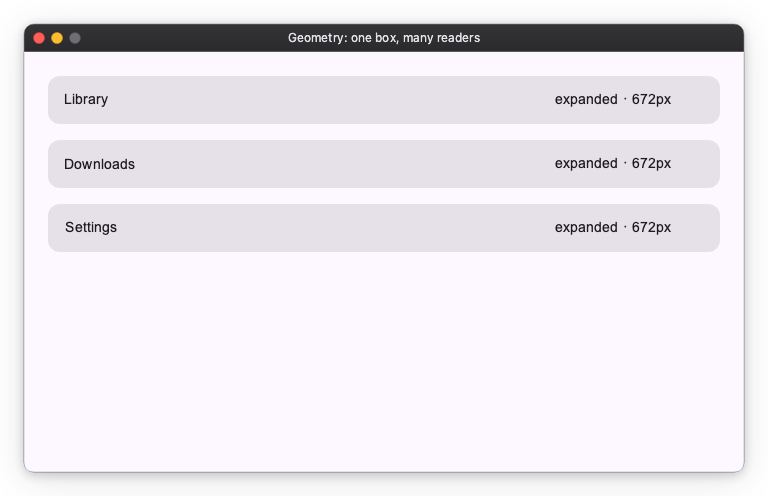
_Section passes nothing down — it does not know that a badge somewhere inside
it cares about the pane's width. Move the badge elsewhere and it reads whatever
pane it lands in.
Two kinds of binding
- Read-only (a label, a
Deckindex): map straight fromsize— e.g.Text(size.map(...)),Deck(index=size.map(...)).Deckaccepts a derived.map(...)index and shows one mounted child by it. - Two-way widget state (a
NavigationRail'sexpanded, which its own menu button can also toggle): a read-only.mapcannot be written back, so mirror the size-derived value into a plainObservableand keep it in sync — and at that pointon_size_changedis usually the simpler tool.
Notes
- Nearest provider wins.
Geometry.of(self)resolves to the nearest ancestorGeometry, so a nested one overrides the window for its subtree. The app installs a rootGeometryprovider at the window, so with no nearer provider a read falls back to it and tracks the window size. - A filling
Geometrymeasures available space.width="wt"makes it fill what the parent offers, so it measures the space available to a pane rather than the child's intrinsic size. - The size lands on the next frame. It is measured during layout and
published between frames, so every consumer — a mapped label or a
Deckswitching arrangements — sees it on the following frame. Imperceptible, and it keeps the layout pass free of subtree rebuilds. - Stable sizes don't re-fire. An unchanged size is de-duped, so a
Geometrywhose size is imposed by its parent cannot drive a feedback loop. Sizeis a(width, height)pair:size.width,size.height, or unpack it withw, h = size.
Choosing between the two
| Use for | |
|---|---|
on_size_changed |
Push, to itself. This component reacts to its own box. No lifecycle override, no subscription, no scope. |
Geometry |
Pull, from a scope. Many widgets, at any depth, read one ancestor's box. |